Along the banks of the Mekong River in Laos, a long-standing partnership is now providing thousands of inhabitants with sustainable access to clean water.
On 20 March 2026, in the village of Nabon, on the Namsa watershed, Lao authorities, technicians, teachers, children and villagers gathered together to celebrate World Water
Day. Behind this water celebration lies a story of lasting cooperation, shared
expertise and human commitment – a story that CCL, alongside OiEau and local
partners, wished to share.
A Small Watershed with Major Challenges
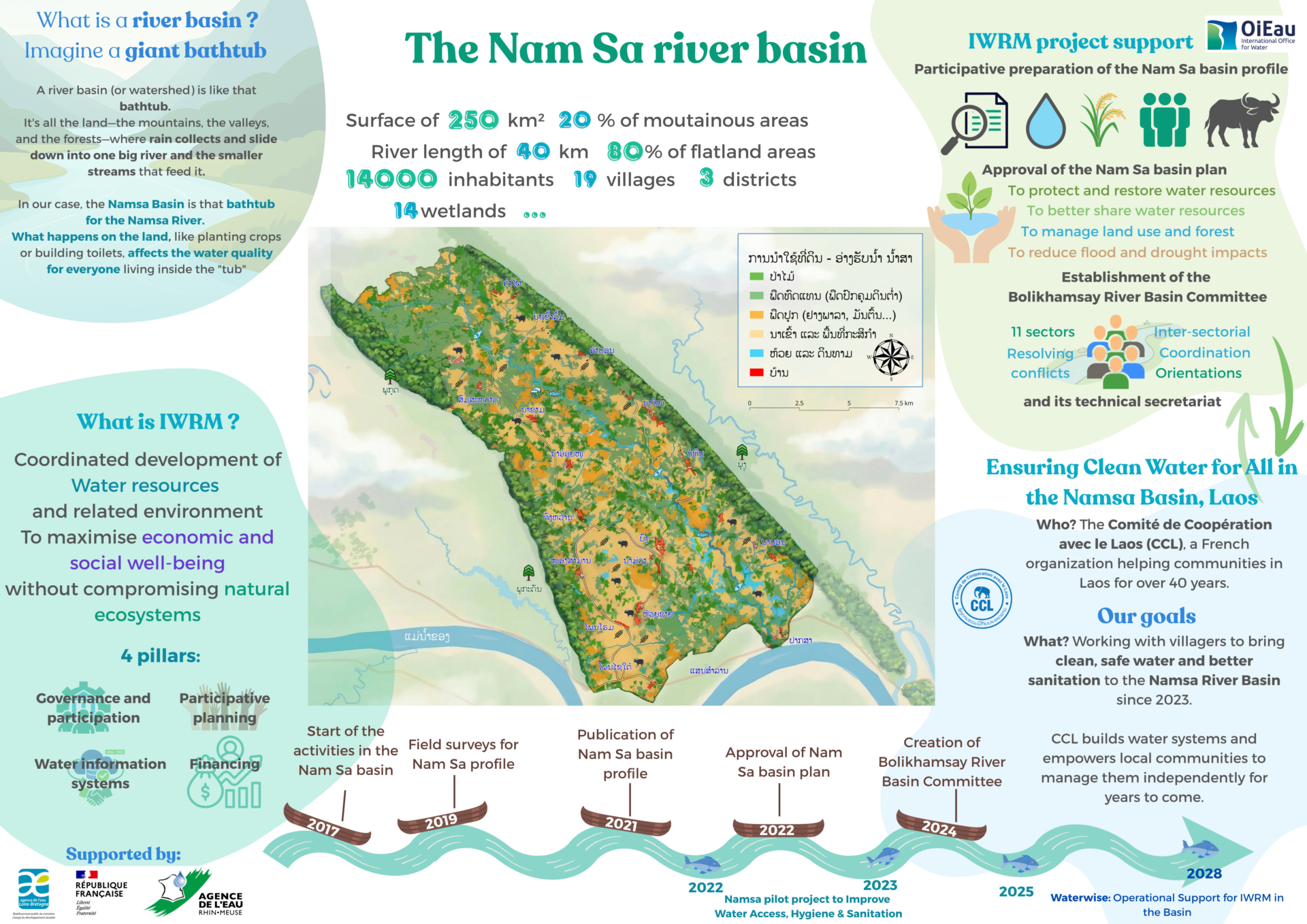
The Nam Sa is a modest river – a 247-square-kilometre watershed on the left bank of the Mekong, in Bolikhamxay Province. Yet this territory concentrates challenges shared across the entire region: pressure on water resources, deforestation and pressure on forested massifs (Pou Ngou, Pou Kadan, Pou Kout), difficulties in accessing drinking water for rural villages, and the need to strengthen local governance and expertise.
It is precisely because these challenges are legible on a human scale that the Nam Sa was chosen as early as 2017 as a pilot area to test Integrated Water Resources Management (IWRM) at the watershed level. This approach considers water not as a simple tap to open or close, but as a common good to be managed collectively, involving all stakeholders: communities, local authorities, government services, and civil society.
A Long-Term Cooperation
The Franco-Lao commitment to water in Bolikhamxay Province is the result of a decade-long cooperation built on trust and perseverance.
From 2017, the International Office for Water (OiEau) begins a cooperation with the Department of Water Resources (DWR) of the Lao Ministry of Natural Resources and Environment (MONRE), with support from the Rhin-Meuse and Loire-Bretagne Water Agencies. This cooperation lays the foundations for integrated water governance in Laos, notably through the creation of LaoWIS – a national water information system – and local capacity-building programmes (e-flow, water body inventory, water quality and flow measurement training, among others).
Since 2017, the Namsa watershed is identified as a priority pilot area to test, on a human scale, the principles of integrated watershed management in Bolikhamxay Province.
In November 2023, CCL begins its work in the watershed with a pilot project for water and sanitation access, in collaboration with the Rural Development Agency (RDA) and with financial support from the Rhin-Meuse Water Agency and the City of Paris. The objective: to concretely improve access to drinking water, strengthen hygiene practices and build the foundations of lasting village-level governance.
2023–2025: Pilot Project Achievements
In partnership with the RDA and provincial offices, CCL built four gravity-fed water supply networks in the villages of Nabon, Nakhoolom and Khambon – including two metered networks in Nabon, serving 189 delivery points for 755 inhabitants. In total, 1,753 people (368 families) now benefit from sustainable access to improved-quality water. Around one hundred water analyses have been carried out, 100% of families in the target villages have been equipped with latrines, and five village water management committees have been established and are now supported.
January 2025: Launch of the AGIRE Project
Building on the pilot project achievements, CCL is now leading the AGIRE project (Support for Integrated Water Resources Management in the Namsa Watershed), funded by the AFD, the Rhin-Meuse Water Agency, the EDF Group Foundation and the City of Paris. This three-year project covers ten villages in the Paksan and Pakkading districts, in partnership with the Ministry of Health, the RDA and OiEau.
The AGIRE Project: A Watershed-Scale Ambition
With AGIRE, the commitment to the Namsa reaches a new milestone. It is no longer only about building infrastructure, but supporting a lasting transformation of water governance across the entire watershed, making each village and each water committee an autonomous and accountable steward of its resource.
A Cross-Sectoral Approach
The project brings together around a single table actors who traditionally work in silos: village committees, the Lao Women’s Union, health services, agricultural and environmental services, local elected officials, NGOs and technical experts. This diversity of stakeholders is at the heart of IWRM : water is not merely a matter of pipes – it is a matter of society.
Concretely, AGIRE plans for the rehabilitation of water infrastructure, strengthening of local technical capacities, the adoption of a watershed-level water conservation action plan, and the establishment of collective systems for sustainable and equitable resource management. Ultimately, ten village committees will be fully autonomous.
Challenges Ahead: Sustaining Momentum Over Time
The results achieved in the Namsa watershed are encouraging, but they
should not obscure the scale of the challenges that remain. Pressure on water
resources is intensifying: deforestation, extensive agriculture, and the
effects of climate change on rainfall patterns and hydrological regimes. The
village committees, still young, need ongoing support to build their autonomy.
The operational implementation of IWRM across an entire watershed
demands a long-term commitment – well beyond a single project or funding cycle.
It requires Lao authorities at all levels to fully take ownership of the tools
and practices of integrated governance. It also requires international partners
to remain present, engaged and coordinated, without substituting themselves for
local actors but helping them to fully claim their role.
LaoWIS, the national water information system built by OiEau with the
DWR, is a valuable tool for evidence-based resource management. But an
information system is only as valuable as the trained, motivated and adequately
resourced teams that feed, maintain and use it. This is precisely the challenge
of local capacity-building that CCL and OiEau are jointly addressing.
20 March 2026 in Nabon: A Symbolic Day
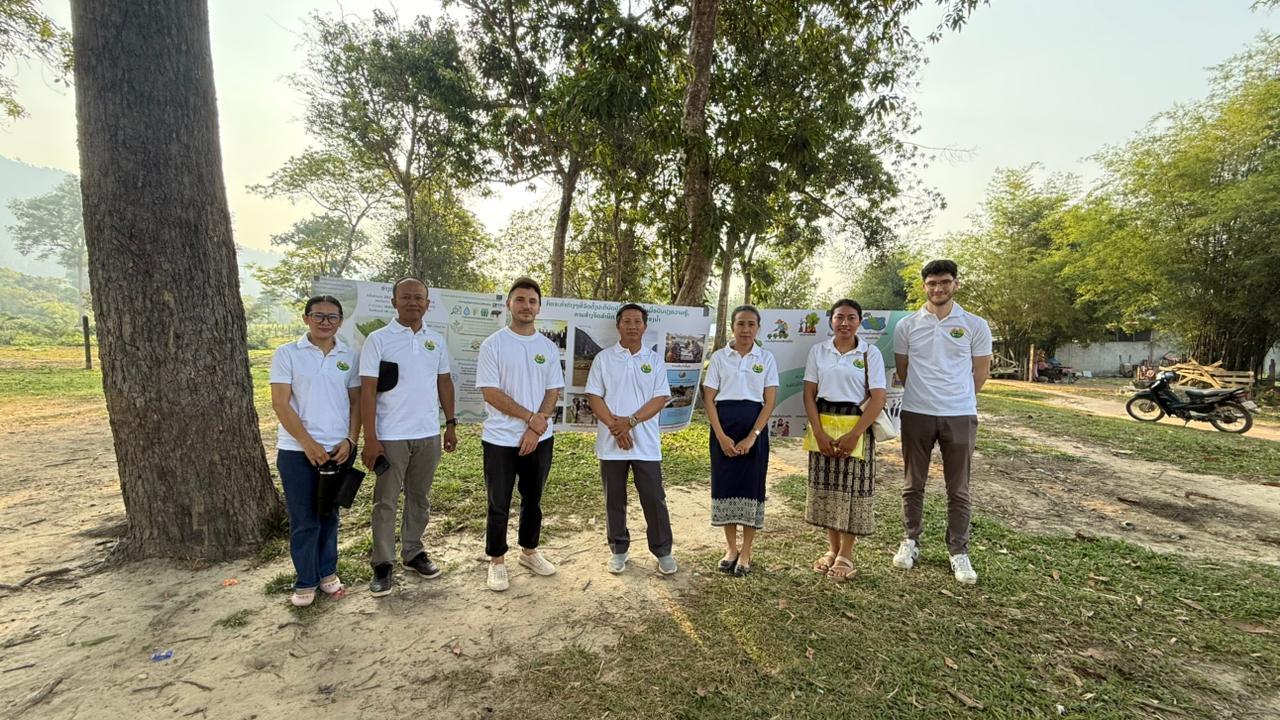
For World Water Day 2026, whose international theme is “Water & Gender Equality”, the CCL team, accompanied by Valérian Guilhen (OiEau) and representatives from the Ministry of Agriculture and Environment and the Provincial Health Office (PHO), helped organise a rich and participatory day in the village of Nabon.
The morning began with an opening ceremony bringing together local authorities, teachers, parents and children around the importance of water and the actions taken in recent years to improve water supply in the village. Quiz games with pupils from the village school helped raise awareness among the younger generation about the wealth and fragility of the Namsa watershed.
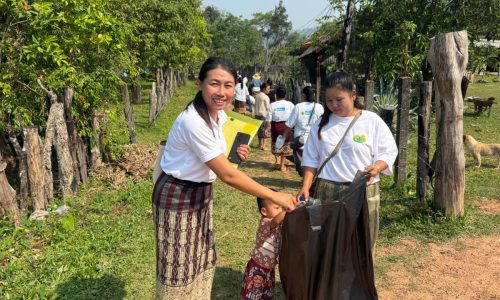
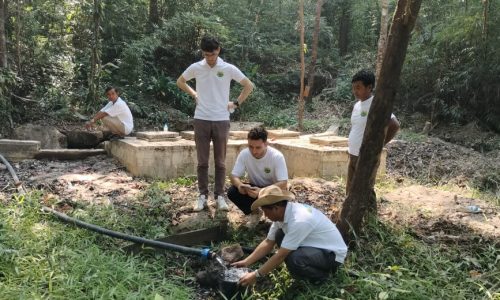
The late morning gave rise to two simultaneous and complementary activities, symbolic of the holistic approach deployed across the watershed. On one side, a community awareness walk through the village lanes, bringing together residents of all ages to collect litter and remind everyone that a clean environment is inseparable from water quality. On the other, the technical team conducted a flow rate test at the water intake built in December 2024 – a measurement that helps ensure the long-term viability of the network and anticipate future needs.
Thank You to All Who Bring Water to Life on the Namsa
World Water Day is also an opportunity to pay tribute to all those who commit every day to keeping water a common good rather than a privilege.
To the Lao Authorities – Ministry of Health, Ministry of Agriculture and Environment and its decentralised bodies – whose involvement guarantees the sustainability of these actions.
To the Village Committees of Nabon, Nakhoolom, Khambon and all the villages of the watershed, whose commitment is the living heart of IWRM.
To NGOs and Technical Partners – OiEau, Rural Development Agency (RDA) – whose expertise and dedication transform ideas into tangible realities for thousands of families.
To Our Financial Supporters without whom none of this would be possible:
Rhin-Meuse Water Agency, Loire-Bretagne Water Agency, French Development Agency (AFD), City of Paris, EDF Group Foundation.